
Report: Live Nation Pursues DOJ Settlement Talks Outside Antitrust Division, Deepening Trump-Era Enforcement Rift
Live Nation Entertainment is reportedly seeking a negotiated exit from the Justice Department’s antitrust lawsuit by engaging senior DOJ officials,…
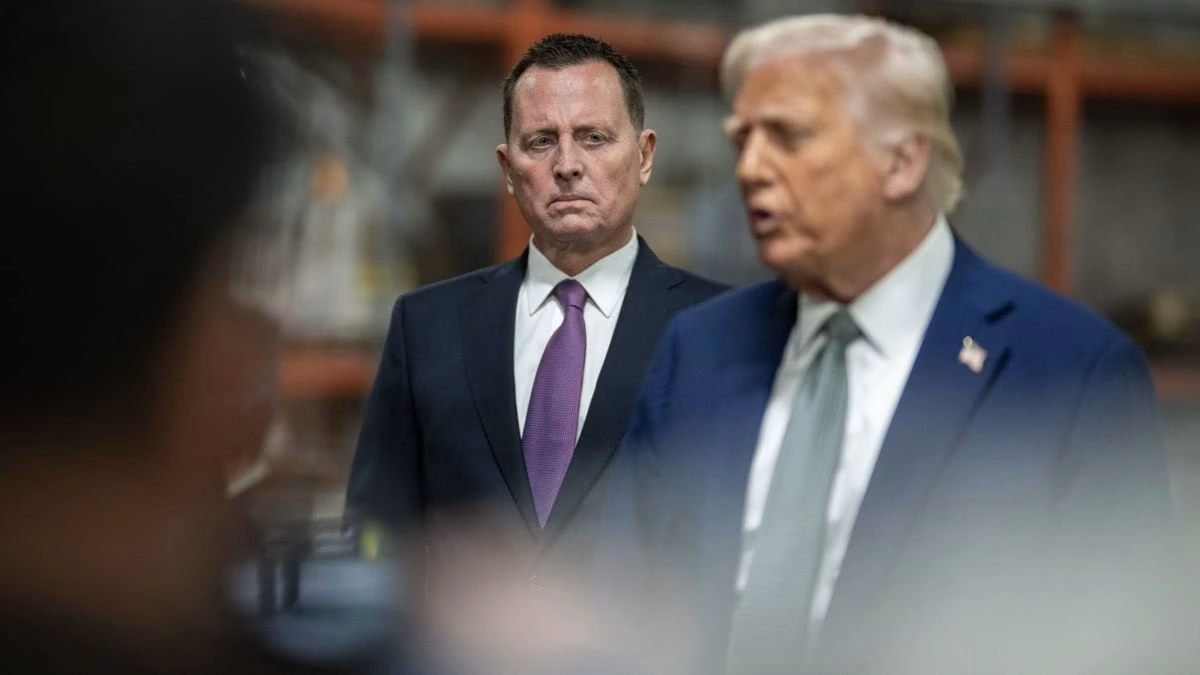
Live Nation Entertainment is reportedly seeking a negotiated exit from the Justice Department’s antitrust lawsuit by engaging senior DOJ officials, according to a report published Sunday by Semafor. If accurate, this effort mirrors a broader Trump-era pattern in which politically connected companies try to bypass career antitrust staff and appeal to higher-level leadership for a friendlier outcome – which makes sense given a lengthy and very pubic effort to get close to the President’s inner circle through flattery, donations, and board influence.
Semafor’s reporting indicates that Live Nation executives and lobbyists have been in talks with senior DOJ officials to avert a trial currently set for March, and that some of those discussions have “sidelined” Antitrust chief Gail Slater, who inherited the Live Nation case from the prior administration but has pursued it toward trial.
A DOJ spokesperson pushed back on Semafor’s characterization, saying the report “contains misinformation” but adding that Slater “is very much involved” in the Live Nation matter — while warning that “anonymous attempts to alter markets or outcomes will not undermine the integrity of this process.” Live Nation declined to comment to Semafor.
Semafor frames the reported settlement push as part of a widening internal rift inside the Trump administration over antitrust enforcement. This rift has surfaced repeatedly in high-profile corporate disputes, where companies sought to bypass Antitrust Division staff by appealing directly to senior leadership, resulting in outcomes that reportedly overruled or diminished antitrust officials’ leverage.
In Live Nation’s case, the significance isn’t simply that the company may want to settle — most corporate defendants do — but that the talks are described as being conducted with senior DOJ officials outside the unit actively prosecuting the monopoly case. That framing, if borne out, reinforces the perception that Live Nation is pursuing political routes to mitigate legal exposure.
FURTHER READING: Live Nation’s Trump Playbook – Cozying Up to Undermine Antitrust Case
Former Trump campaign manager Kellyanne Conway and Trump-aligned attorney Mike Davis have advised Live Nation on its settlement approach, with Conway playing a leading role in recent weeks and meeting with both Slater and representatives connected to Deputy Attorney General Todd Blanche’s office. Trump ally Richard Grenell was also added to Live Nation’s board last year, despite widespread backlash to Grenell’s main tie to the entertainment world – his appointment to lead the board of the Kennedy Center, since renamed with Trump’s name added.
Just last week, Live Nation announced a tour it was promoting featuring Kid Rock – an artist who is close with the President and been openly critical of it – at a late January hearing before a Senate subcommittee, he called the company a “a monopoly dressed up as innovation” and touted his independence from their influence – while he was almost certainly already negotiating a deal for that tour, if it hadn’t already been finalized.
Settlement Wouldn’t End the Multi-State Fight for Live Nation – But It Would Shift the Battlefield
Even if Live Nation reached a settlement with the federal government, it would not automatically resolve parallel actions brought by state attorneys general across the country. But a federal settlement could still reduce pressure on the company and reshape the strategic terrain, including how aggressively the case proceeds toward a courtroom test and what remedies remain on the table.
The terms of any potential settlement remain unclear. The Biden-era DOJ officials who brought the case in 2024 argued that nothing short of structural remedies — potentially including a breakup — would restore competition.
The pattern that seems clear currently is that Live Nation’s broader strategy is a two-front campaign: reduce or neutralize existential federal antitrust risk in Washington while simultaneously backing state-by-state legislation that critics argue would rewrite ticketing rules in ways that constrain independent resale competition and steer consumers back into Ticketmaster’s ecosystem.
FURTHER READING: Live Nation’s Two-Front Strategy: Fight Breakup Pressure in D.C. While Rewriting State Laws
That state-level track has intensified in recent weeks, including proposals in two major-market states that would largely implement Live Nation’s stated legislative agenda by strongly regulating the resale marketplace while largely leaving things untouched in a primary ticketing market allegedly monopolized by one company.
In California, Assemblymember Matt Haney introduced AB 1720, pitching it as a consumer-protection measure that would cap resale prices at 10% above face value and earning it strong public backing from both Live Nation Entertainment and groups aligned with mega-promoter Irving Azoff. This support comes despite the bill text publicly available on the legislative tracking site being minimal, with no reference to the sweeping cap being promoted – suggesting the proposal is still being shaped in the background even as industry-aligned groups have rushed to endorse it.
In New York, Sen. James Skoufis’ proposed “Affordable Concerts Act” also includes a hard resale price cap structure that opponents argue could weaken regulated, above-board resale markets and push transactions into less protected channels. The full language of the legislation (which was released Friday, also after Live Nation had expressed its public support) blends some real consumer-facing reforms with multiple policy items long favored by Ticketmaster and Live Nation.
The Throughline: Politics as a Substitute for Structural Remedies
Live Nation’s settlement push as a fresh test of whether high-level political engagement can blunt a major antitrust case — particularly one that, at least in its original filing, aimed at structural change rather than narrow behavioral tweaks.
For the ticketing industry, the emerging question is whether Live Nation can trade courtroom risk for a settlement that stops short of breakup — while simultaneously pressing state legislatures to lock in rules that target resale and narrow consumer escape routes from Ticketmaster’s platform.
Read next
More headlines
Jun 12, 2026
FIFA Faces Fresh Attendance Questions After Empty-Seat Images Circulate
FIFA’s expanded World Cup has barely kicked off, but images circulating on social media are already raising questions about fan…
Jun 12, 2026
Jinkx Monsoon Returns to ‘Oh, Mary!’ for West End Engagement
Jinkx Monsoon is set to return to the role of Mary Todd Lincoln in the West End production of “Oh,…

Jun 12, 2026
Bleachers to Offer $30 Discounted Tickets to Madison Square Garden Show
The alt-rockers of Bleachers announced a limited number of discounted tickets to their upcoming gig at New York City’s Madison…